Jnana is “book knowledge” or “theory” because it entails the renunciation of all work, the suppression of the senses, and the rejection of the world as false. Vijnana is realized knowledge because it does not come about by mental speculation and the cessation of actions but rather by engagement in active devotional service.
Moscow—Members of the Hare Krishna sect said Monday that despite an easing of restrictions on political dissent, Soviet authorities are still detaining followers in prisons and psychiatric hospitals.
The Bhagavad-Gita is an authoritative statement given to Arjuna by Lord Krishna. It must be borne in the mind that the Bhagavad-Gita was spoken on a battlefield. Before the battle, Arjuna declined to fight with his own kinsmen.
When the group arrived at the Zanzibar airport, members of Parliament, national television correspondents, and leading citizens welcomed Navayogendra Swami.
In the spirit of Srila Prabhupada’s voyage to America in 1965, devotees are bringing Krishna consciousness to the Hawaiian Islands on the Jaladutta II boat.
A mother-to-be ponders karma, reincarnation, and devotional service to Krsna. by Visakha-devi dasi When, one crystal-clear morning in January of 1982, my husband Yadubara and I first learned that we were parents-to-be, we had many of the usual questions first-time parents have. But since we were devotees of Krsna, the answers to our questions were […]
A look at the worldwide activities of the International Society for Krishna Consciousness (ISKCON) Italians Gain Spiritual Perspective on Animal Rights Florence, Italy—Animal-rights activists recently met at ISKCON’s Villa Vrndavana rural community here to discuss the spiritual dimensions of the animal-rights movement. Participants included members of the Italian Vegetarian League, the Italian League for Animal […]
Transcendental Commentary on the Issues of the Day The Intellectual Animal by Rupanuga dasa Eating, sleeping, mating, and defending. These propensities are common to the animal, including the human animal. Especially for humans, fulfilling these propensities creates a constant challenge: how to eat well, how to sleep comfortably, how to make more suitable arrangements for […]
The gurukula students in Mayapur are preparing for their future roles in society by performing simple character-building austerities and cultivating qualities like honesty and compassion.
It is true that sometimes if a sincere devotee maintains some material attachment, Krishna will crush his material success so that he is left only with his attachment to Krishna. After all, material opulence in this world is temporary.
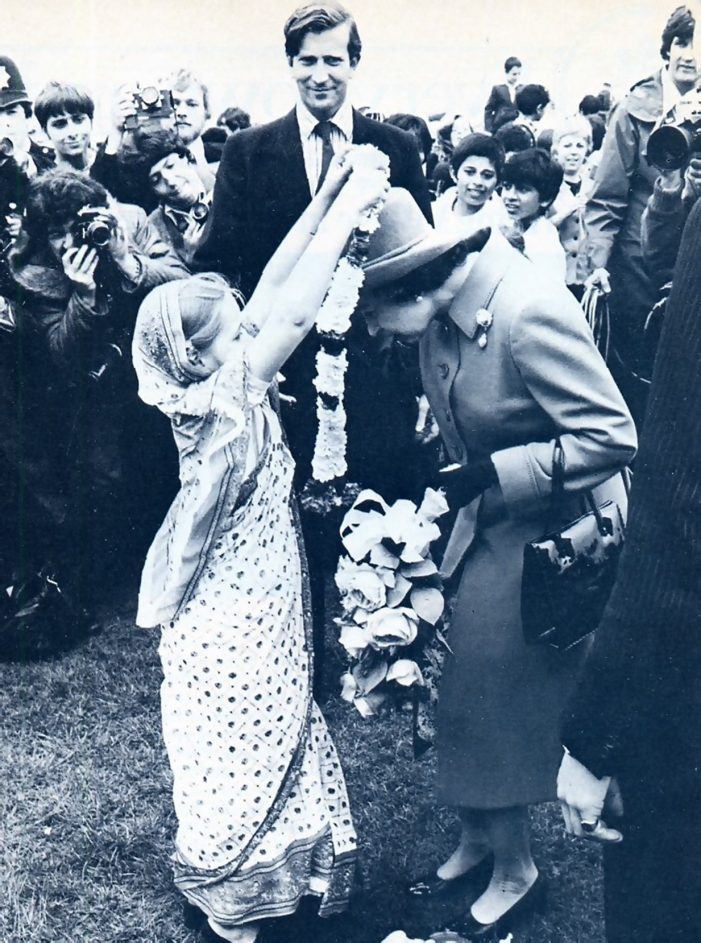
Queen Elizabeth II bows slightly to receive a garland worn earlier by the Krsna Deity at London’s ISKCON center. Making the presentation is eight ·year-old Bhaktimati dasi.
Hare Krsna devotees from Denver started ISKCON’s fifteenth farm community, a 340-acre spread atop Sunshine Mesa and overlooking the Peonia-Hotchkiss fruit valley, on the western slope of the Colorado Rockies.
The International Society for Krishna Consciousness (ISKCON) is a movement aiming at the spiritual reorientation of mankind through the simple process of chanting the holy names of God.
In London on Soho Street just off Oxford Street, English devotees of Lord Krsna have opened a new cultural center that includes a temple, a theater, and a vegetarian restaurant.
The original consciousness of the self cannot be awakened as long as it is contaminated by material affection. The soul in his pure state does not want anything material.
It is so unfortunate that in most parts of India we know very little about Lord Caitanya. All I knew was that He was a very great devotee; I knew very little about His pastimes and sankirtana movement.