Nature, as Darwin pointed out, imposes an unpitying competition of her own upon all beings within her grasp. Therefore even the socialist, even the pacifist must kill to prolong his life, must inflict pain on someone or something (like cattle or chickens) to secure his own pleasure.
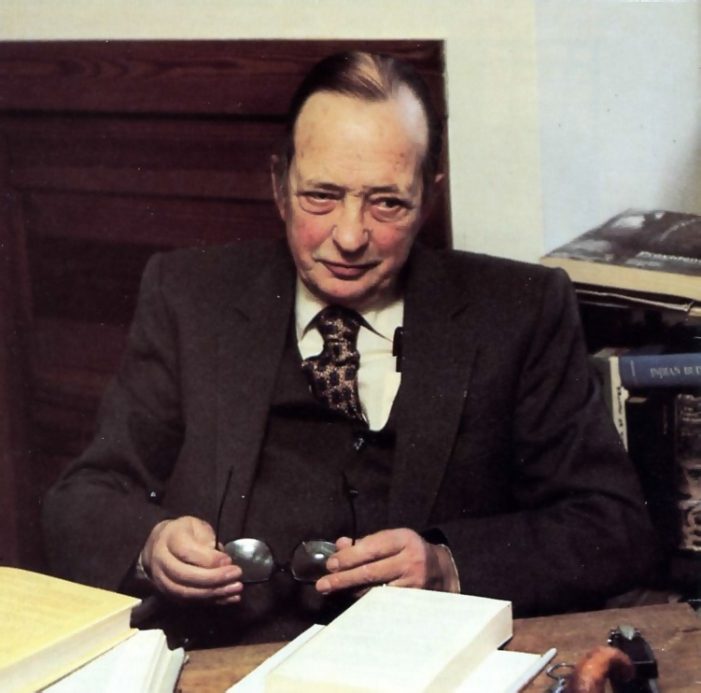
Professor A. L. Basham, one of the world’s most highly respected authorities on ancient Indian civilization, has written extensively on the Hindu and Buddhist religious traditions.
Modern history is full of liberation movements. Even the American revolution and the formation of the American nation can be seen as a type of liberation movement that signaled the eventual collapse of European colonialism.
A huge cross section of the earth’s population, both in nuclearly armed and conventionally armed nations, now feel shock and outrage at the current overmilitarized condition of the world. Why did we ignore this nuclear insanity for so long?
People do not know that they are spoiling their life. They are thinking, “I’ve got a very nice apartment, a very nice car, a very nice wife, a very nice income, a very nice social position.” All these material attractions make us forget the purpose of our life—to worship Krsna.
While recently watching the evening news, I saw that almost the entire show was about killing and death: a murder, a rash of drug poisonings, a massacre of refugees by military forces, and a sampling of wars and preparations for war.
The Bible says, “Thou shalt not kill.” Yet this simple moral maxim seems impossible for most Americans to accept, or even understand—even those clamoring for a return to morality.
In this era of rising unemployment, it is common to see hundreds of people lining up at the doors of companies offering a few jobs—and those who don’t get those jobs often wind up at the doors of other institutions, namely our hospitals and prisons.
The solution to the problem of male domination and exploitation is not for women to become dominators and exploiters—to compete for social, economic, and political supremacy. So-called supremacy can’t satisfy women any more than it satisfies men.
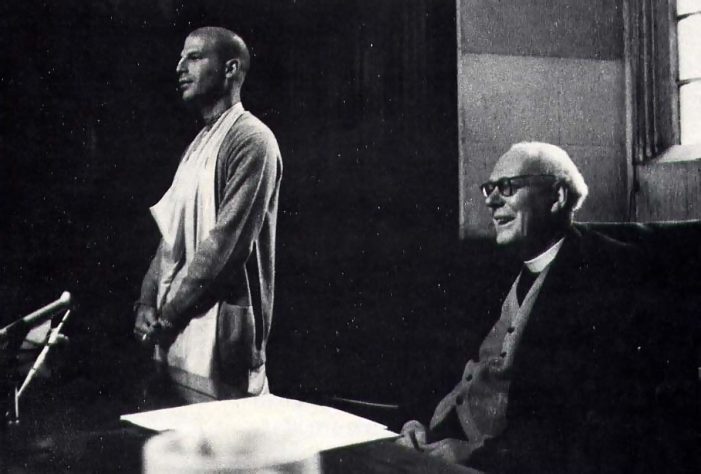
One of the highlights of last summer’s Festival of India in Britain was an ecumenical dialogue at Westminster Abbey, where British clergymen gathered to learn more about the Hare Krsna movement and its role in English society.
There is no benefit or public welfare in material questions and answers, because ultimately they cannot save us from—nor clearly explain—death. This is illustrated in the story of the scholar and the boatman.
By Rayarama Das Brahmachary On Tuesday evening, October 8, Dr. Benjamin Spock received the Gandhi Peace Award at the Community Church of New York. This award is a far-distant poor relative of the Nobel Prize, which went this year to the less controversial figure of a French jurist. There was no big money gift at […]
Ghosts are denied any existence in the modern scheme of things, but nevertheless the exploits of such beings are widely reported in newspapers, periodicals and books, and on television as well.
The trouble with elections is they give us the sensation things have changed because our representatives have changed. Year after year, century after century, institutions, administrations and world leaders come and go while the common never gets what he wants: satisfaction.
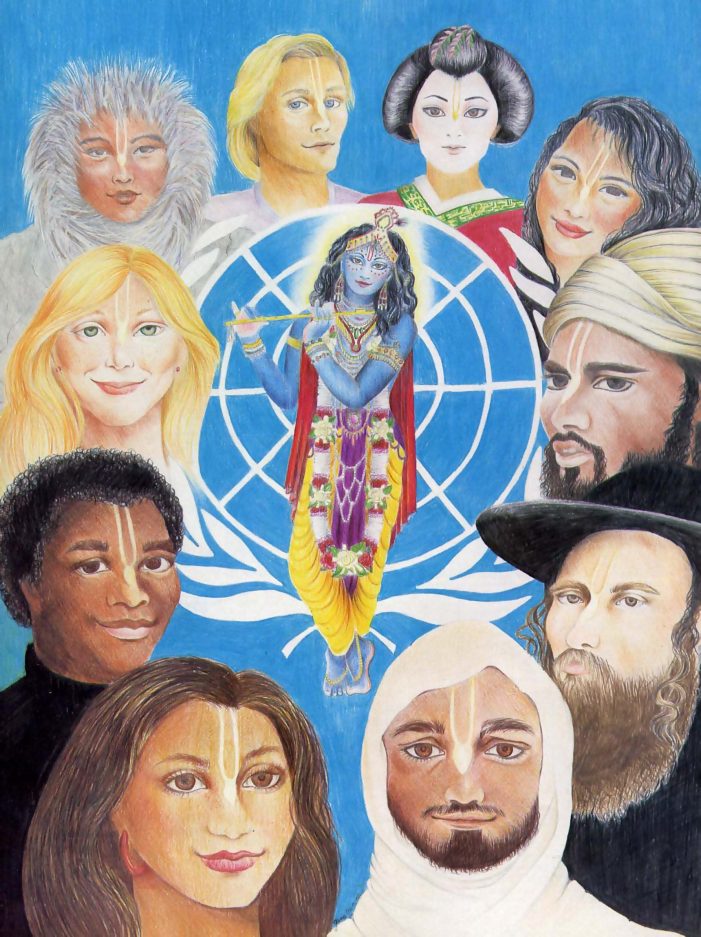
There are many international societies, such as the United Nations. So the idea of an international society is very nice, but we must try to understand what the central idea of an international society should be.
So God’s role in preventing a nuclear holocaust is not peripheral—it is crucial. Humankind, having created such a disastrous situation, should study God’s instructions in the revealed scriptures and try to understand how to rectify their mistakes.
Nationalism demands that we abandon our real spiritual identity and instead fight like dogs and cats. Since conflicts of interest between nations are endless, nationalism can never be the basis of lasting peace, which must stand on a superior awareness of the oneness of all life.
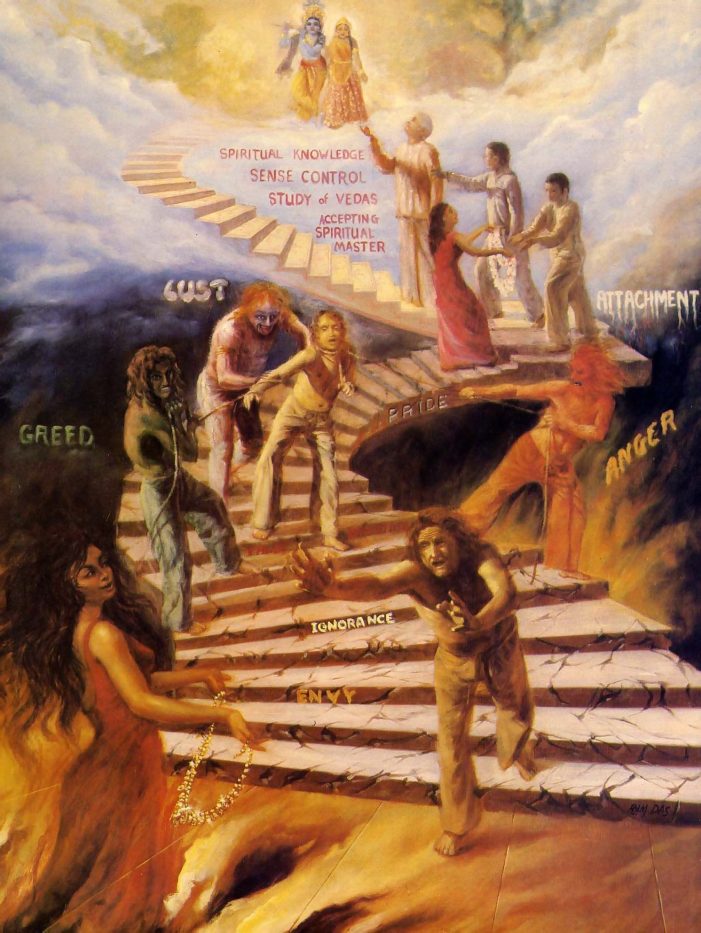
Sex life, according to the Vedic wisdom, is the greatest cause of material bondage because it is the greatest pleasure of material life. Therefore it must be restricted, and the restriction is to marry and to have sex only for the purpose of generating children.
This material nature is constituted in such a way that we have to suffer; it is God’s law. And we are trying to relieve the suffering by patchwork remedies. Everyone is trying to get relief from suffering; that is a fact. The whole struggle for existence is aimed at getting out of suffering.
The poet John Berryman was my teacher at the University of Minnesota the year he jumped from a bridge over the Mississippi and killed himself at the age of fifty-seven. In some respects, his suicide puzzled me.