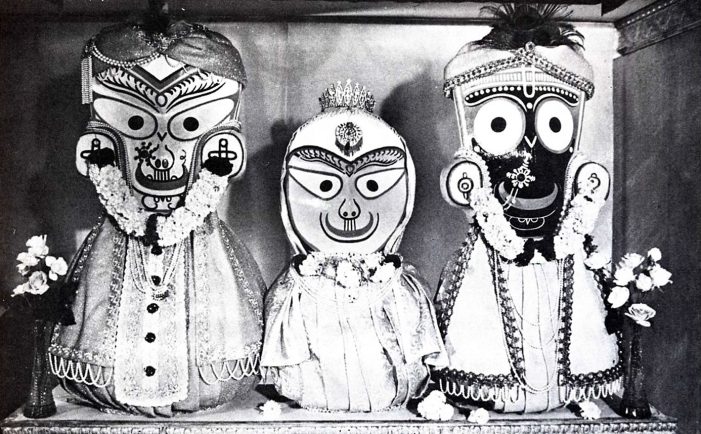
I am staying here at the temple in Atlanta, and this has upset my parents very much. They started crying on the phone, and my mother even fainted once. Now I see what you meant when you told me that the family ties are much stronger in Indian families than in American families.
Automation, in the form of computers is an attempt to exercise control, not only of the mechanical process itself, but of the human being who directed it, turning him from an active to a passive agent, and finally eliminating him altogether.
Twenty-eight percent of all Americans, according to a Gallup poll cited in the Los Angeles Times on October 13, 1976, have seen through the sham and now believe the moon landing to be a fake.
Cows, mothers, giving milk. And from milk comes butter, ghee, cheese, sandesa, yogurt, ice cream… And in a civilized land her dung is used for fertilizer and fuel, and her mate, the bull, is pulling your plow. They should never be killed.
In light of so much terrorism these days and the constant threat of war, many people would probably agree with the Vedic literature’s statement that this world is frought with “danger at every step.”
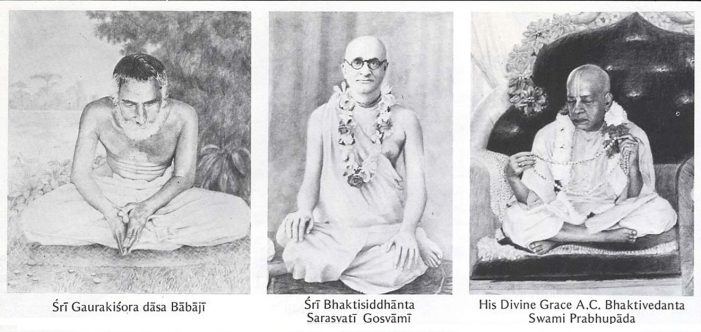
Many times, when people inquiring about Krsna consciousness hear from us about the importance of disciplic succession, they are not able to grasp what we are talking about. We say, “Krsna consciousness is coming down in disciplic succession.”
I want to talk of the real guide, the pure devotee of God who showers unlimited love and mercy upon all living entities because he is the dearmost representative of God.
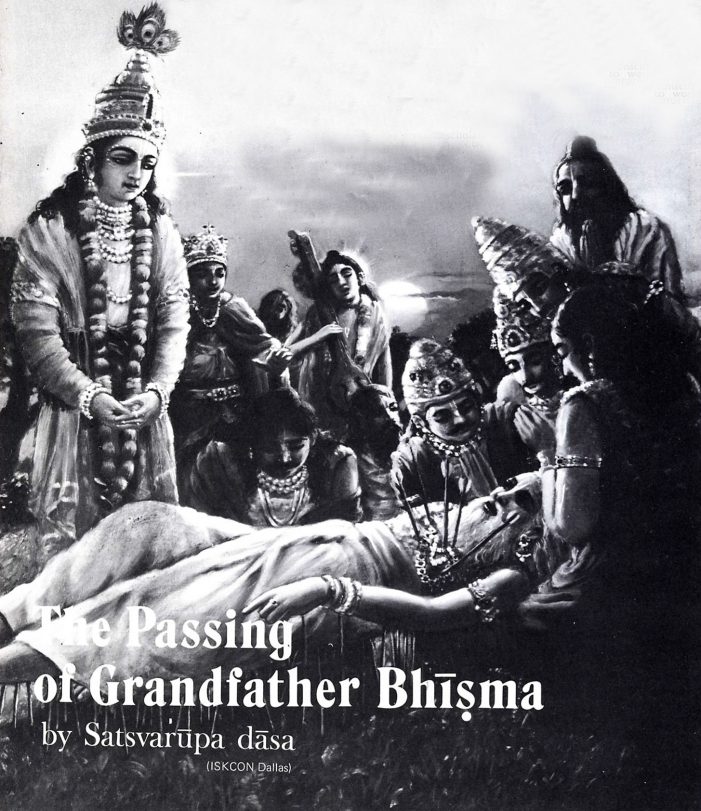
Grandfather Bhisma was lying at the point of death on a bed of arrows which had been shot through his body. Because he was the most famous warrior of his time and an expert yogi, all the great men of the universe went to the Battlefield of Kuruksetra where he lay dying.
Even if one has achieved great success in business, or has amassed great wealth, a nice family, fame, or any amount of worldly or mystical power, still dissatisfaction at the inner core of one’s being is liable to occur.
Krsna consciousness not only allows for love but is constituted of nothing but love. In fact, by practicing Krsna consciousness, one gradually comes to realize that supreme love which permeates all beings and objects throughout the universe.
In the 1960s terms like yoga, karma, and mantra entered the American language. The rock ‘n’ roll culture of the hippies also popularized terms of Vedic spirituality, simultaneously creating new misconceptions.
The four orders of social life called varna are scientifically arranged for the material progress of society, and the four spiritual orders called asrama are designed for natural progress in self-realization.
Kardama Muni practiced meditative penances on the bank of the Sarasvati River for a period of 10,000 years. It is understood that the yoga system, in order to be rightly practiced, must be performed by persons who possess a very long duration of life.
In Karma yoga, when you are working for Krishna, you can do your office tasks, speak to people on business, and do whatever you duty happens to be, for it all becomes part of your single aim: to return to God.
The election year has ended, but the debates continue. And one of the most controversial issues is the role of religion in government. The Hare Krsna movement takes no side in the political battle, but it can offer thoughtful advice to help solve a complex problem.
While writing this month’s column, I am confined with an illness that has stopped my normal work. It’s a discouraging, uncomfortable interlude, yet I am seeing how illness can also bring one valuable realizations.
Service of the Lord, especially in dressing and decorating the temple, accompanied by musical kirtana and spiritual instructions from the scriptures, can alone save the common man from the hellish cinema attractions and the rubbish sex-songs broadcast everywhere by radios.
Generally people pray, perform rituals, and so on, in hopes of attaining temporary goals: better health, a good marriage, success in business. But in Bhagavad-gita Sri Krsna advises that those who practice religious life by seeking material boons are missing the real point.
Kali-yuga is a fallen age, the age of hypocrisy and quarrel. In Kali-yuga the basic principles of religion are abandoned, the government is ruled by the lowest class of men, and society lives on the basis of animal life.